-
Courses

Courses
Choosing a course is one of the most important decisions you'll ever make! View our courses and see what our students and lecturers have to say about the courses you are interested in at the links below.
-
University Life

University Life
Each year more than 4,000 choose University of Galway as their University of choice. Find out what life at University of Galway is all about here.
-
About University of Galway

About University of Galway
Since 1845, University of Galway has been sharing the highest quality teaching and research with Ireland and the world. Find out what makes our University so special – from our distinguished history to the latest news and campus developments.
-
Colleges & Schools

Colleges & Schools
University of Galway has earned international recognition as a research-led university with a commitment to top quality teaching across a range of key areas of expertise.
-
Research & Innovation

Research & Innovation
University of Galway’s vibrant research community take on some of the most pressing challenges of our times.
-
Business & Industry
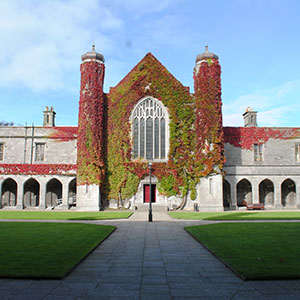
Guiding Breakthrough Research at University of Galway
We explore and facilitate commercial opportunities for the research community at University of Galway, as well as facilitating industry partnership.
-
Alumni & Friends

Alumni & Friends
There are 128,000 University of Galway alumni worldwide. Stay connected to your alumni community! Join our social networks and update your details online.
-
Community Engagement

Community Engagement
At University of Galway, we believe that the best learning takes place when you apply what you learn in a real world context. That's why many of our courses include work placements or community projects.
 Accessibility & Language
Bachelor of Nursing Science (Mental Health)
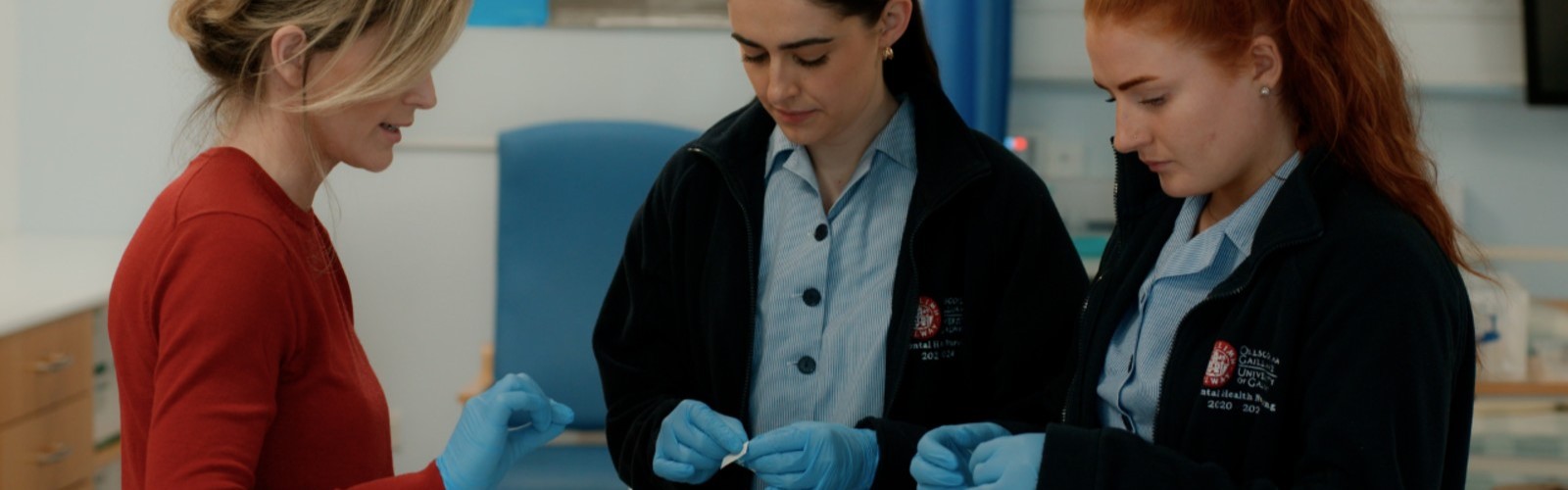

Bachelor of Nursing Science (Mental Health)
College of Medicine and Health- Title of Award
- Bachelor of Nursing Science (Mental Health)
- CAO Code
- GY516
- CAO Points
- 403 (2026)
- Average Intake
- 20
- Delivery
- On Campus
- NFQ
- Level 8
- QQI/FET/FETAC Places
- 3
- Award Type
- Major
- Next Intake
- September 2027
- Duration
- 4 years
Why Choose This Course?
Course Information
The BSc (Hons) in Mental Health Nursing at the University of Galway prepares you for a rewarding and meaningful career supporting the mental well-being of others. Over four years, you’ll build the knowledge, confidence, and clinical skills needed to become a highly skilled mental health nurse. You’ll learn in a supportive, dynamic environment—guided by expert lecturers and working alongside experienced mental health professionals across a wide range of settings.
This internationally recognised degree leads to registration with the Nursing and Midwifery Board of Ireland (NMBI), enabling you to practise as a Registered Mental Health Nurse. To be eligible for registration, you will complete the programme learning outcomes as set out by the NMBI (2023).
Throughout the course, you’ll gain a strong foundation in mental health nursing—balancing academic learning with real-world experience:
- Acquire the knowledge, professional values and discipline specific competences to fulfil the role of the Registered Nurse to deliver safe, high quality, compassionate, ethical, legal and accountable practices across the life spectrum and in diverse healthcare settings.
- Demonstrate knowledge, clinical skills and professional behaviours that are underpinned by the Nursing and Midwifery (NMBI) Code of Professional Conduct and Ethics for Registered Nurse and Registered Midwives (NMBI 2025).
- Practice as a competent Registered Nurse to assess, plan, priorities, deliver and evaluate nursing care based on a comprehensive and systematic assessment of health and nursing needs in consultation with the person receiving such care, their representative and the multi-disciplinary team.
- Apply theoretical principles to the practice of nursing using professional judgement, critical reasoning, problem-solving and reflection derived from an evidence base of nursing and from the applied life, health and social sciences.
- Deliver person-centred, high quality and safe nursing care based on a collaborative relationship with a person receiving such care, that respects her/his dignity, autonomy, self-determination and rights to make health and life choices across the health spectrum.
- Demonstrate skills of effective communication, delegation, inter-professional liaison and team working to promote the quality and safety of the health care environment.
- Maintain competence to develop and enhance the capacity for self-awareness, reflective practice, leadership and professional scholarship.
- Apply evidence from an appraisal of research studies relevant to the division of nursing to the practice of nursing.
The course helps you grow as a professional and as a person—building your confidence, leadership skills, and understanding of how to support people and families during difficult times.
Modules and Learning Style
Students will take 23 theory modules and 8 clinical modules during the four years of the programme. The table below outlines the modules taken each semester for each year of the programme. Modules are designated as either theory or clinical practice:
- Theory modules: Give you the knowledge you need to understand mental health conditions, nursing approaches, and best practices in care.
- Clinical modules: Give you hands-on experience working with real patients under expert supervision.
- Modules are also identified as shared, profession-discipline specific or shared/profession-discipline specific.
- Shared modules refer to modules that are taken by all groups (General, Mental Health, and Midwifery students)
- Profession-Discipline Specific is a specialist module, which focuses on the Discipline/Profession specialty.
- Similarly, practice modules allow students to explore “new” knowledge in the reality of the practice setting, thus providing students with an opportunity to integrate theory and practice.
- Internship provides students with an opportunity to consolidate their clinical skills and become confident in their abilities. Modules in Year 4 Semester 2 concentrate on preparing students for the transition from student to qualified mental health nurse.
Curriculum Information
Curriculum information relates to the current academic year (in most cases).Course and module offerings and details may be subject to change.
Glossary of Terms
- Credits
- You must earn a defined number of credits (aka ECTS) to complete each year of your course. You do this by taking all of its required modules as well as the correct number of optional modules to obtain that year's total number of credits.
- Module
- An examinable portion of a subject or course, for which you attend lectures and/or tutorials and carry out assignments. E.g. Algebra and Calculus could be modules within the subject Mathematics. Each module has a unique module code eg. MA140.
- Subject
- Some courses allow you to choose subjects, where related modules are grouped together. Subjects have their own required number of credits, so you must take all that subject's required modules and may also need to obtain the remainder of the subject's total credits by choosing from its available optional modules.
- Optional
- A module you may choose to study.
- Required
- A module that you must study if you choose this course (or subject).
- Required Core Subject
- A subject you must study because it's integral to that course.
- Semester
- Most courses have 2 semesters (aka terms) per year, so a three-year course will have six semesters in total. For clarity, this page will refer to the first semester of year 2 as 'Semester 3'.
Year 1 (60 Credits)
RequiredNU1107: Health & Applied Biosciences 1 - 10 Credits - Semester 1RequiredNU1116: Introduction to Mental Health Nursing - 5 Credits - Semester 1
RequiredNU1111: Foundations of Mental Health Nursing Practice - 10 Credits - Semester 1
RequiredNU1119: Clinical Practice 1 & 2 (Mental Health) - 15 Credits - Semester 1
RequiredNU1106: Practice Assessment 2 (PY) - 0 Credits - Semester 2
RequiredNU104: Placement Hours - 0 Credits - Semester 2
RequiredNU138: Practice Assessment (PY) - 0 Credits - Semester 2
RequiredNU1112: Research and Evidence for Practice 1 - 5 Credits - Semester 2
RequiredNU1114: Communication and Interpersonal Skills - 5 Credits - Semester 2
RequiredNU1118: Mental Health Nursing 1 - 10 Credits - Semester 2
Year 2 (60 Credits)
RequiredNU2217: Mental Health Nursing 4 - 5 Credits - Semester 3RequiredNU2307: Clinical Practice 3 & 4 - 15 Credits - Semester 3
RequiredNU2214: Mental Health Nursing 2 - 10 Credits - Semester 3
RequiredNU2200: Health & Applied Biosciences 2 - 10 Credits - Semester 3
RequiredNU2202: Research and Evidence for Practice 2 - 5 Credits - Semester 4
RequiredNU225: Practice Asessment - 0 Credits - Semester 4
RequiredNU208: Specialist Placement Hours Module - 0 Credits - Semester 4
RequiredNU2215: Mental Health Nursing 3 - 5 Credits - Semester 4
RequiredNU2204: Applied Psychology for Nursing & Midwifery - 5 Credits - Semester 4
RequiredSP2118: Sociology of Health and Healthcare - 5 Credits - Semester 4
Year 3 (60 Credits)
RequiredNU3108: Mental Health Nursing 5 - 10 Credits - Semester 5RequiredNU3109: Mental Health Promotion and Recovery - 5 Credits - Semester 5
RequiredNU3110: Mental Health Nursing 6 - 5 Credits - Semester 5
RequiredNU3112: Clinical Practice 5 & 6 - 15 Credits - Semester 5
RequiredNU348: Practice Assessment 2 (PY) - 0 Credits - Semester 5
RequiredNU314: Elective - 5 Credits - Semester 6
RequiredNU3104: Law and Ethics - 5 Credits - Semester 6
RequiredNU3105: Medicines and Clinical Practice - 10 Credits - Semester 6
RequiredNU3111: Mental Health Nursing 7 - 5 Credits - Semester 6
RequiredNU399: Clinical Hours - 0 Credits - Semester 6
RequiredNU337: Practice Assessment - 0 Credits - Semester 6
Year 4 (60 Credits)
RequiredNU4111: Leading and Developing Practice for Mental Health Nursing - 10 Credits - Semester 7RequiredNU499: Clinical Hours - 0 Credits - Semester 7
RequiredNU489: Internship Assessment 4 - 0 Credits - Semester 7
RequiredNU488: Internship Assessment 3 - 0 Credits - Semester 7
RequiredNU487: Internship Assessment 2 - 0 Credits - Semester 7
RequiredNU486: Internship Assessment 1 - 0 Credits - Semester 7
RequiredNU470: Practice Assessment - 0 Credits - Semester 7
RequiredNU4107: Clinical Practice 7: year 4 - 10 Credits - Semester 7
RequiredNU4110: Literature Review - 20 Credits - Semester 7
RequiredNU4112: Transition to Practice for Mental Health Nursing - 5 Credits - Semester 8
RequiredNU4109: INTERNSHIP, General and Mental Health - 15 Credits - Semester 8
RequiredNU4108: Transition to Practice - 5 Credits - Semester 8
As part of the Global Health- Nursing and Midwifery in the International Setting Elective Module for our Undergraduate General, Mental Health and Midwifery Programmes, students who sign up will have the opportunity to undertake a service learning in Africa –Tanzania, Zambia and Kenya.
Global Health Exposure: As part of the Global Health - Nursing and Midwifery in the International Setting Elective Module for our Undergraduate General, Mental Health and Midwifery Programmes, students who sign up have the opportunity to undertake a service learning in Africa -Tanzania and Kenya.
Research Driven Education: University of Galway's strong research foundation ensures that students are well-informed and evidence-based practitioners. The curriculum is designed to foster critical thinking, enabling students to apply theoretical principles to nursing practice using professional judgment, critical reasoning, problem-solving, and self-reflection derived from an evidence base and applied life, health, and social sciences
Clinical placement: Students complete a total of 144 weeks of clinical placement over the four-year programme. These placements are based within HSE West, primarily in partnership with Galway Roscommon Mental Health Services and the Saolta University Health Care Group. All placements are supervised by qualified mental health nurses, ensuring safe, supportive, and high-quality learning experiences.
Clinical Internship: In Semester 2 of Year 4, students complete a 36-week paid clinical internship. During this time, they take on greater responsibility while remaining under supervision. The internship allows students to consolidate their clinical skills and confidently prepare for the transition from student to qualified mental health nurse.
Following qualification, you will have the experience needed to work as a mental health nurse within the HSE and other health services. It is possible to specialise in several mental health services including Child and Adolescent mental health nursing, Cognitive Therapy, Behavioural Therapy, Eating Disorders, Mental Health Nursing of Older Persons and Substance Misuse/Addiction Counselling services. Also, you can work in private healthcare or within the voluntary and independent sector. You may also choose to pursue a career in teaching, research or management.
Graduate Opportunities
Graduates of this programme are well-prepared for postgraduate education and professional development. The School of Nursing and Midwifery offers a range of options, including:
- MSc in Advanced Practice (Mental Health)
- Other master's programmes in specialist or advanced nursing practice
- Opportunities for PhD research in mental health nursing
This degree opens the door to a lifelong and evolving career in mental health care—both in Ireland and internationally.
As part of the Global Health - Nursing and Midwifery in the International Setting Elective Module for our Undergraduate General, Mental Health and Midwifery Programmes, students who sign up can undertake a service learning in Africa –Tanzania, Zambia and Kenya.
Students of the Mental Health Nursing degree programme will undertake clinical placements regularly throughout the programme, and will work in a variety of settings, including:
- In-patient mental health services
- Community mental health services
- Medical and community health
- Child and adolescent mental health services
- Voluntary organisations
- Recovery and rehabilitation services
- Services for the older person
- Substance misuse and addiction treatment services
- Primary mental health care
- Community mental health services for people experiencing homelessness
- Perinatal mental health services
- Self-selected placements
- Forensic services
These placements enhance the link from theory to practice and provide you with a broad range of clinical learning opportunities to develop your competence to qualify as a mental health nurse. Practice placement is an essential component of the programme, ensuring that you have sufficient opportunities to develop skill and competence in care provision and decision making, meeting the requirements for professional registration with the Nursing and Midwifery Board of Ireland (NMBI 2025). Placements in Mental Health Nursing can be anywhere in Galway Roscommon Mental Health Nursing Services. Students are required to travel to external placements and may apply to the Galway Roscommon Mental Health Nursing Services for support in meeting travel and accommodation costs.
During the clinical internship period, students are paid a salary.
While on clinical placements, students are supervised by a Preceptor. This is a nurse who has been specially prepared to guide and direct student learning. Students are also supported by the Nurse Practice Development Coordinator and the Clinical Placement Coordinator (CPC), who ensures that learning outcomes are identified and achieved. Students in the School of Nursing & Midwifery and Evidence Science at University of Galway are also well supported through the Academic Link who are attached to placement areas. The academic link will support preceptors, students, nurse practice development coordinator, and clinical coordinators that work in partnership with the Galway Roscommon Mental Health Nursing Services.
This four-year degree, delivered in partnership with HSE West, leads to the award of Bachelor of Nursing Science (Mental Health Nursing). Graduates are eligible to register in the Psychiatric Division of the Nurses’ Register, maintained by the Nursing and Midwifery Board of Ireland (NMBI)—the regulatory body for the nursing profession in Ireland.
Academic staff teaches the course from School of Nursing, Midwifery and Evidence Science in collaboration with specialist mental health nurses from clinical practice.
The Mental Health Lecturers include:
At the School of Nursing, Midwifery and Evidence Science, we aim to deliver a high-quality learning environment that embeds intellectual curiosity, innovation and best practice in learning, teaching and student support to enable students to achieve their full academic potential. We provide a range of learning experiences which assist our students to engage with subject experts, develop attributes and perspectives that will equip them for life and work in a global society. We make use of innovative technologies, and we have a world class library that enhances their development as independent, lifelong learners. Examples of the opportunities provided for learning on this programme are:
E-Learning technologies
Information associated with lectures and assignments is often communicated via a Virtual Learning Environment (VLE) called Canvas. A range of e-learning experiences is also embedded in the programme throughout, for example: interactive group workshops in a flexible learning space, podcasts and interactive web-based learning activities.
Lectures
Introduce information about new topics as a starting point for further self-directed private study/reading. Lectures also provide opportunities to ask questions, gain feedback and advice on assessments (normally delivered in large groups to all year group peers).
Practical and Simulation Based Education
We provide opportunities to develop technical skills and apply theoretical principles to real-life or practical contexts in our clinical skills labs and simulation suite. All mental health students have opportunities to engage in interprofessional education (IPE) activities.
Self-directed study
This is an essential part of life as a University of Galway student when important private reading, engagement with e-learning resources, reflection on feedback to date and research work for assignments is carried out.
Seminars/tutorials/workshops
Significant amounts of teaching are carried out in small groups (typically 10-20 students). These provide an opportunity for students to engage with academic staff who have specialist knowledge of the topic, to ask questions of them and to assess progress and understanding with the support of peers. Students are also expected to make presentations and other contributions to peer groups.
Attendance
Students are expected to attend 100% of classes within the modules.
How Will I Be Assessed?
Assessments will be carried out in a variety of formats, including written assignments, exams, poster and oral presentations, dissertations, project work, case studies and clinical skills assessment.
- The way in which students are assessed will vary according to the learning outcomes of each module. Details of how each module is assessed is provided to all students at the start of each module.
In accordance with Nursing and Midwifery Board of Ireland regulations (2025), the total minimum requirements of the programme are 62 weeks of practice learning in the programme. Students undertake approximately 26 weeks of supernumerary placement and 36-weeks clinical internship that runs across semester two of year three and from November-June of year four. During the clinical internship period, students are paid a salary.
The School of Nursing, Midwifery, and Evidence Science is committed to supporting students in relation to both their academic and personal development; the structures that are in place to support students within the school and university are presented below.
Academic Advisor
Each student is allocated an academic advisor for the duration of the programme. This advisor will monitor the students’ academic progress and is available to advise and support the student if they encounter difficulties either personal, academic or relating to clinical practice whilst undertaking the programme.
Link out to additional
- Academic Writing Centre- Providing one-on-one tutorials and email consultations on essay writing
- Library- The Library provides a wide range of services to all students. Learn about these services, opening times and lots more on their website.
Academic Skills Hub- This online resources hub aims to support all students to develop the key skills required for academic success and learn about IT and digital skills, workshops, assignments and exam techniques. Student Support Officer- Available to meet with students who wish to discuss personal, academic, financial or any other issues that may arise while in University.
- Student Academic Advisors- Available to meet with students who wish to discuss personal, academic, financial or any other issues that may arise while in University.
The Disability Support Service (DSS) is available to University of Galway students who need supports or reasonable accommodations due to the impact of a disability, ongoing physical or mental health condition, or a specific learning difficulty.
- The University counselling services provides a free hybrid service of in-person, one-to-one counselling, and online counselling. They provide group counselling and workshops. The counselling service support about 10% of the student population each year.
- Student Health Unit Provides a wide variety of medical support services including GP services, sexual health support serviceand vaccination.
Our undergraduate students have a remarkable record of success and are recognised each year in the Dr Henry Hutchinson Stewart Medical Scholarships and Prizes.
The Tarpey Award recognises excellence related to clinical practice.
The Community Engagement Award recognises outstanding community engagement.
The School of Nursing, Midwifery and Evidence Science is a research-intensive school with a strong reputation for producing high-quality, internationally relevant research. Our work focuses on improving nursing and midwifery practice, enhancing patient outcomes, and informing national and international health policy. Our research, expertise and activities are centred on the following themes:
Healthy and Active Ageing
Maternity Care and Women's Health,
Randomised Trials and Evidence Synthesis
We are committed to collaborative research and have established partnerships with national and international universities, health services, and policy-making bodies. Our research collaborations include:
- The statutory Health Services, Department of Health, and acute hospital services
- Voluntary agencies, other state bodies, and professional healthcare organisations
- Interdisciplinary collaborations with academics across the University of Galway
Our researchers work closely with healthcare professionals, policymakers, and service users to ensure our research has real-world impact and relevance.
Course queries:
Programme Director:
Margaret Maguire
School of Nursing, Midwifery and Evidence Science
University of Galway
E: margaret.maguire@universityofgalway.ie
T: 091 492832
Accreditations & Awards


-(3).png)

I enjoyed the practical side of learning working in vast amount of clinical areas. I gained a lot of exposure to various mental illnesses and I was able to gain a true understanding of how to care for someone with a mental illness. I enjoyed the workshops and the different speakers that came to the University to speak to us about their clinical area. I enjoyed the variety in mental health nursing, from elderly care to child mental health. Each area is unique and offers a great chance to explore.
Laura Greene
Student (Final year, 4th year)
The Mental Health degree at University of Galway has offers a unique and important foundation for my nursing career. It has provided me with the opportunity to discover my academic potential as well as enhancing my skills in becoming a qualified mental health nurse. I’ve met many inspiring people,both fellow students in class and service users during placement. There’s strong support from lecturers and staff in college to the clinical coordinators and staff you meet in interesting placements.
Ava Fowley
Graduate
Meet our Employers
Entry Requirements and Fees
Minimum Entry Requirements
Minimum Grade H5 in two subjects and passes in four other subjects at O6/H7 level in the Leaving Certificate, including Irish, English, Mathematics, a laboratory science subject (i.e., Chemistry, Physics, Biology, Physics with Chemistry (joint) or Agricultural Science), and any two other subjects recognised for entry purposes.
Additional Requirements
Health requirements
Nursing and midwifery are demanding professions, both physically and emotionally. This requires good mental and physical health and the ability to achieve the required competencies of a nurse. Students will be required to complete a Preplacement Health Assessment Form and as necessary undergo a medical assessment/screening. This aligns with the Nursing & Midwifery Board of Ireland framework as detailed in "Nursing/Midwifery A Career for You (2023)"
Vaccination and Screening
Registered students must engage with the School of Nursing and Midwifery Vaccination and Screening programme in collaboration with the clinical partners and in line with the National Immunisation Advisory Committee (NIAC) Immunisation and Health Information for Health Care Workers and others in At Risk Occupations. Vaccinations are not mandatory; however, a student who declines to be immunised against these illnesses or who has a confirmed medical contraindication to a vaccine, and as a result will not be in a position to acquire the necessary skills or core competencies and in agreement with clinical partners will be denied placement and unable to continue on this programme.
Statutory and Mandatory Training
Statutory and Mandatory training are defined as training and skills that must be successfully completed and updated to participate and remain skilled in safe clinical practice.
Statutory Training: This training which is explicitly required by law; or required on the instruction of a statutory body on the basis of specific legislation. Statutory training is mandatory for all students attending placements.
Mandatory training: This training is compulsory training that is deemed essential by an organisation for the safe and efficient delivery of services. The Statutory and Mandatory training and Skills for ALL students are stipulated by the Department of Health and the Health Service Executive and include the following:
- Manual Handling & People Handling training is completed in year 1 and updated in year 3.
- AHA Basic Life Support (BLS) Provider Course (complete in year 1 and updated in year 3)
Prevention and Control of Healthcare Associated Infections to include:
- Hand hygiene (update at least once in each academic year)
- Exposure to blood and body fluids (Updated in year 3)
- Waste management (Updated in year 3)
- Personal Protective Equipment (Updated in year 3)
- Children First (Updated in year 3)
- Irish National Early Warning System (INEWS)
- Safety Interventions Training - teaches students to recognise, prevent, and safely deescalate aggressive or distressed behaviour.
This is not an exhaustive list and is subject to change.
Students must satisfactorily participate and obtain certification of completion/achieve competency in training and other health requirements to commence/continue with the programme.
Garda Vetting
Garda Vetting in line with the requirements of the programme nursing and midwifery students in the University of Galway will undertake placements with external agencies, bringing them into contact with the public during which they will assume positions of trust. To ensure the protection of the public, and justify public trust and confidence, the University is committed to ensuring that only suitable candidates undertake these programmes. University of Galway uses the Garda National Vetting Bureau (GNVB) and where applicable, may liaise with other vetting services* to assess the suitability of applicants for admission to such programmes. The University of Galway requires that students on nursing and midwifery programmes be Garda Vetted before they fully complete their registration as a student of the University. Students who have not completed their Garda Vetting will be registered provisionally until Garda Clearance is obtained. In the event where applicants do not meet the Garda Vetting requirements of the University, registration on such programmes is subject to cancellation. Overseas Police Clearance – Students with addresses outside of Ireland: Please note that Garda clearance will only cover addresses in the Republic of Ireland and Northern Ireland. If you have resided in countries outside of the Republic of Ireland / Northern Ireland for a period of 6 months or more from the date of your 16th birthday, it is mandatory for you to furnish the Admissions Office with a Police Clearance Certificate from those countries stating that you have/have not convictions recorded against you while residing there. Please ensure you apply for this as soon as possible as it can take up to 3 months to obtain.
Admissions Office
Our Admissions Office provides additional detail relevant to CAO applicants including key dates, FAQs and instructions for non-school leavers.
Irish and European (EU/EFTA/UK) Applicants
Apply via the CAO. See the CAO Handbook for useful information on applying through the CAO.
Mature Applicants
Apply via the CAO by 1 February. To apply for a place as a mature student, you must be 23 years of age on or before 1 January of the year of entry. Further information available here.
QQI/FET/FETAC Applicants
Apply via the CAO. See our QQI/FET/FETAC Applicants page for information on places available and entry requirements,
QQI/FET/FETAC Places
There are 3 places available on GY516 Bachelor of Mental Health Nursing. Holders of recognised QQI (FETAC Level 5/6) qualifications in any of the following awards who achieve a minimum of five distinctions, may be admitted on a competitive basis to Year One:
5M4468 Community and Health Services 5M4339 Health Care Support
5M3782 Health Service Skills
Additional Conditions: Applicants must attain at least 5 distinctions (80% or better) which must include two of the following in order to be eligible to apply for (GY516)
5N0749 Anatomy and Physiology, and 5N4325 Nursing Theory & Practice or 5N0758 Care Support.
Fees for Academic Year 2026/27
| Course Type | Year | EU Tuition | Student Contribution | Non-EU Tuition | Levy | Total Fee | Total EU Fee | Total Non-EU Fee |
|---|---|---|---|---|---|---|---|---|
| All | €4,606 | €2,500 | €28,000 | €140 | €2,640 | €7,246 | €28,140 |
- Most EU students applying through the CAO will be eligible for the ‘Free Fees Initiative’. You can find out more here.
- If you are eligible for a means tested SUSI grant this may cover 100% of this Student Contribution Charge. If you are 100% eligible SUSI will pay the Student Contribution Charge of €2,500 on your behalf.
- The Student Levy It is payable by all students and it is not covered by SUSI
- Where the course duration is greater than 1 year, there is an inflationary increase approved of 1.8% per annum for continuing year fees. This applies to non-EU fees.
- You can find additional detail on the Fees Office webpage including FAQs and how fee status is assessed.
Uniforms
Uniforms and name badges for clinical placements are supplied by the Health Service Executive.
Application Process
Students applying for full undergraduate degree programmes from outside of the European Union (EU), and who are liable for full non-EU tuition fees, should apply online via Apply to University of Galway. Our application portal opens on the 1st October each year for each the following September.
Further Information
Please visit the international application webpage for further information on closing dates, documentation requirements, application fees and the application process.

Why University of Galway?
World renowned research led university nestled in the vibrant heart of Galway city on Ireland's scenic West Coast.
Contact the School of Nursing, Midwifery and Evidence Science
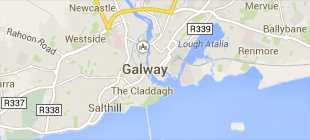
Áras Moyola, Upper Newcastle, Galway


Downloads




Meet Our Alumni
Course Introduction
Start your journey towards a rewarding career with our BSc in Mental Health Nursing at University of Galway. Learn to support mental well-being through expert-led teaching, simulation, and hands-on placements—preparing you to deliver person-centred, compassionate care in a dynamic healthcare environment.