-
Courses
Courses
Choosing a course is one of the most important decisions you'll ever make! View our courses and see what our students and lecturers have to say about the courses you are interested in at the links below.
-
University Life

University Life
Each year more than 4,000 choose University of Galway as their University of choice. Find out what life at University of Galway is all about here.
-
About University of Galway
About University of Galway
Since 1845, University of Galway has been sharing the highest quality teaching and research with Ireland and the world. Find out what makes our University so special – from our distinguished history to the latest news and campus developments.
-
Colleges & Schools
Colleges & Schools
University of Galway has earned international recognition as a research-led university with a commitment to top quality teaching across a range of key areas of expertise.
-
Research & Innovation

Research & Innovation
University of Galway’s vibrant research community take on some of the most pressing challenges of our times.
-
Business & Industry
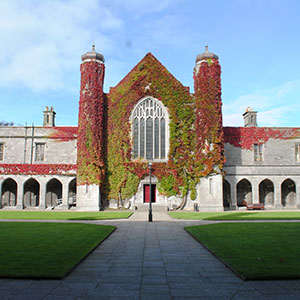
Guiding Breakthrough Research at University of Galway
We explore and facilitate commercial opportunities for the research community at University of Galway, as well as facilitating industry partnership.
-
Alumni & Friends

Alumni & Friends
There are 128,000 University of Galway alumni worldwide. Stay connected to your alumni community! Join our social networks and update your details online.
-
Community Engagement
Community Engagement
At University of Galway, we believe that the best learning takes place when you apply what you learn in a real world context. That's why many of our courses include work placements or community projects.
 Accessibility & Language
June Search is on for citizen scientists to report honey bees
Search is on for citizen scientists to report honey bees
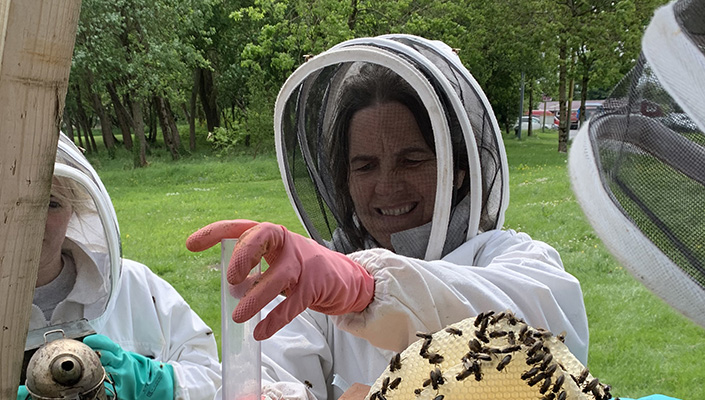
Professor Grace McCormack holds a wild native Irish honey bee at a log hive on University of Galway's campus. Credit University of Galway
Jun
24
2026
Posted: 10:24 IST
Honey bee researchers have launched a call for citizen scientists to report sightings of wild honey bee nests, beehives and foraging.
Are honey bees foraging in your garden? Do you have beehives in or around Galway city? If the answer to either of these questions is yes, or you know of where there are beehives near you, then the team would love to hear from you!
There are over 100 different bee species in Ireland with one of those being the honey bee. They are relatively smaller than other bee species and not as ‘fluffy’ as a bumblebee. People are familiar with honey bees being kept in hives by beekeepers but honey bees are a wild species too.
More importantly, native wild honey bees are now considered as endangered under the International Union for Conservation of Nature, but wild colonies are a frequent sight in Ireland where they live in cavities, in trees, roofs or walls.
Professor Grace McCormack, Galway Honey Bee Research Centre at University of Galway, said: “In Co Galway, to date, we have recorded more than 190 wild colonies, although we know there are likely to be many more.
“However, there is a large gap in our knowledge – we do not know how the native wild honey bee and other wild pollinators are affected by managed bees, which live in beehives. We don’t know because we don’t know how many beekeepers there are or where their hives are.”
University of Galway has 12 hives in Galway city and is keen to ensure that its beekeeping is sustainable, not adversely impacting wild honey bees, other beekeepers, or other bee species.
To better understand how many hives would be a sustainable number, the research team are exploring what other hives might be in the area and where its bees, and other bees, are getting their food.
The research team would love to hear from anyone who has any information on:
- Honey bee apiaries, hives or nest sightings in the area
- Honey bees feeding on pollinator friendly plants in your gardens or area
Professor McCormack added: “The native Irish honey bee, also known as the black bee, is uniquely adapted to Ireland’s climate. However, it is currently under threat from non-native imports, climate change, invasive species and a lack of resources such as food and nesting space.
“This research is important as it will provide a clearer understanding of honey bee and pollinator activity in Galway, to help us develop conservation measures and sustainable management strategies for apiaries that can be applied within Galway and nationally.”
All information provided will be kept confidential.
To submit sightings and queries, please contact Pamela Madigan at P.Madigan1@universityofgalway.ie or 087 4474811 or Professor Grace McCormack at grace.mccormack@universityofgalway.ie or 086 0227227.
Ends