-
Courses

Courses
Choosing a course is one of the most important decisions you'll ever make! View our courses and see what our students and lecturers have to say about the courses you are interested in at the links below.
-
University Life

University Life
Each year more than 4,000 choose University of Galway as their University of choice. Find out what life at University of Galway is all about here.
-
About University of Galway

About University of Galway
Since 1845, University of Galway has been sharing the highest quality teaching and research with Ireland and the world. Find out what makes our University so special – from our distinguished history to the latest news and campus developments.
-
Colleges & Schools

Colleges & Schools
University of Galway has earned international recognition as a research-led university with a commitment to top quality teaching across a range of key areas of expertise.
-
Research & Innovation

Research & Innovation
University of Galway’s vibrant research community take on some of the most pressing challenges of our times.
-
Business & Industry
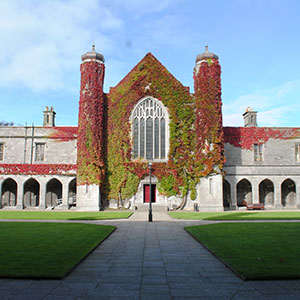
Guiding Breakthrough Research at University of Galway
We explore and facilitate commercial opportunities for the research community at University of Galway, as well as facilitating industry partnership.
-
Alumni & Friends

Alumni & Friends
There are 128,000 University of Galway alumni worldwide. Stay connected to your alumni community! Join our social networks and update your details online.
-
Community Engagement
Community Engagement
At University of Galway, we believe that the best learning takes place when you apply what you learn in a real world context. That's why many of our courses include work placements or community projects.
 Accessibility & Language
February Scientists show how to predict world’s deadly scorpion hotspots
Scientists show how to predict world’s deadly scorpion hotspots
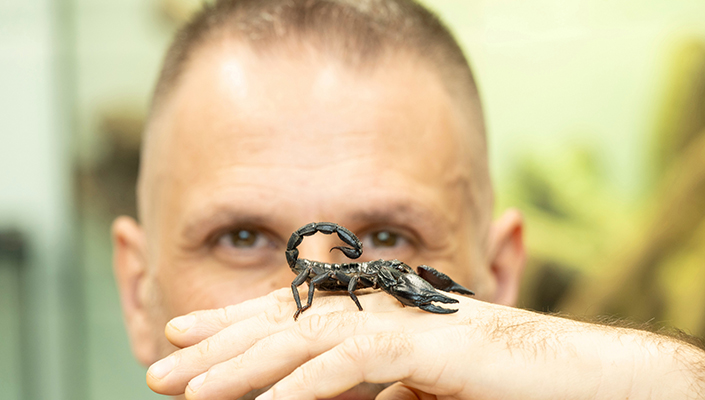
Dr Michel Dugon, Head of the Venom Systems Lab at University of Galway, with a Giant Asian forest scorpion (Heterometrus sp.). Credit: Andrew Downes, Xposure
Feb
15
2026
Posted: 09:36 GMT
International research team pinpoints high-risk areas to inform global scorpion sting prevention
An international team of scientists have identified how to pinpoint and predict hotspots for some of the most dangerous species of scorpion in the world.
The researchers have established the key environmental conditions that determine where lethal, venomous arachnids thrive - findings that could help shine a light on flashpoints for scorpion stings in tropical regions across the globe.
The team of scientists used field observations in Africa combined with computer modelling to predict where dangerous scorpion species are most likely to be found and what factors influence their distributions.
Their analysis uncovered a striking pattern - soil type largely determines where most scorpions live, while temperature, both average and seasonal ranges, play a key role for some species.
Crucially, not all scorpions behave alike. Some are adaptable and widespread, while several others showed extremely restricted predicted distributions, suggesting narrow habitat requirements and localised risk zones.
The research was conducted by an international team from University of Galway, in partnership with University Ibn Zohr in Morocco.
The findings of the study are published in Environmental Research Communications. It focuses on central Morocco, one of the most severe global hotspots for scorpion stings, and aims to guide prevention strategies, as well as the development of new diagnostic tools and antivenoms.
Dr Michel Dugon, Head of the Venom Systems Lab at University of Galway and senior author of the study, said: “The findings could save lives. By pinpointing where dangerous scorpions are most likely to appear, health authorities can target awareness campaigns, train frontline medical staff, and focus community prevention in high-risk areas, especially protecting children. The approach can be applied wherever scorpions pose a threat, from Brazil to the Middle East and India.”
Scorpion stings are a hidden global public health crisis, particularly across tropical and subtropical regions. Every year, more than 2 million people are stung. While most stings cause pain and swelling, some species can deliver venom that leads to very severe illness and death, especially in children and older people. Globally, scorpion stings are estimated to claim the lives of more than 3,000 children annually.
While antivenoms exist for a range of scorpion species, medical teams often struggle to identify which species is responsible, making timely, effective treatment difficult.
To address this issue, the researchers used a computer-mapping tool called Maximum Entropy to predict where dangerous scorpions live and what environmental conditions they prefer.
The analysis uncovered the striking patterns. Using globally available data on soil, temperature, and other habitat factors, the scientist demonstrates a way to pinpoint high-risk scorpion areas outside Morocco, including regions of the tropics where detailed species records are limited.
The research was carried out by established and doctoral scientists from both universities, with support from University of Galway undergraduate students who travel to Morocco annually as part of their Bachelor of Science Zoology programme.
Dr Dugon added: “Overall, we know very little about the ecology of scorpions, their venom and the best way to treat scorpion stings. Our international collaborative efforts aim to develop new tools for the prevention, diagnostic and treatment of scorpion stings globally. This requires multidisciplinary teams including public health specialists, clinicians, zoologists and members of local communities.”
Fouad Salhi, doctoral researcher at the University Ibn Zohr of Agadir and first author of the study, said: “This research shows how biodiversity data can inform public health policies. By combining long-term fieldwork with ecological modelling, we were able to identify where dangerous scorpions are most likely to occur. We aim to have real-world impact — supporting prevention strategies, improving medical preparedness, and ultimately contribute to the reduction of the burden of scorpion stings, both in Morocco and beyond.”
Dr Colin Lawton, Head of Zoology at University of Galway and co-author of the study, said: “University of Galway is gaining momentum as a centre of excellence in zoological research, addressing questions of global importance, from fish stock to mammal conservation and animal-borne disease mitigation. We are very proud to integrate our BSc Zoology students into our research activities and international partnerships.”
The full study in Environmental Research Communications is available at https://iopscience.iop.org/article/10.1088/2515-7620/ae3fef.
Ends
Related News
4 August 2026
Researchers design implant that fights ovarian cancer from the inside
29 July 2026
People of all ages invited to explore mathematical ideas through art
28 July 2026
University of Galway calls for public involvement in developing high blood pressure pathway
27 July 2026
Archaeologists uncover rare Neolithic tombs in Galway
20 July 2026
World premiere of Irish National Opera’s Testament to open at University of Galway