-
Courses

Courses
Choosing a course is one of the most important decisions you'll ever make! View our courses and see what our students and lecturers have to say about the courses you are interested in at the links below.
-
University Life

University Life
Each year more than 4,000 choose University of Galway as their University of choice. Find out what life at University of Galway is all about here.
-
About University of Galway

About University of Galway
Since 1845, University of Galway has been sharing the highest quality teaching and research with Ireland and the world. Find out what makes our University so special – from our distinguished history to the latest news and campus developments.
-
Colleges & Schools
Colleges & Schools
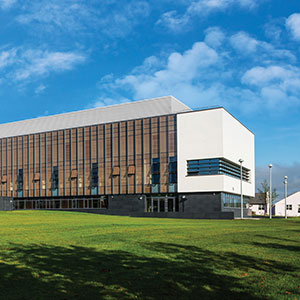
University of Galway has earned international recognition as a research-led university with a commitment to top quality teaching across a range of key areas of expertise.
-
Research & Innovation

Research & Innovation
University of Galway’s vibrant research community take on some of the most pressing challenges of our times.
-
Business & Industry
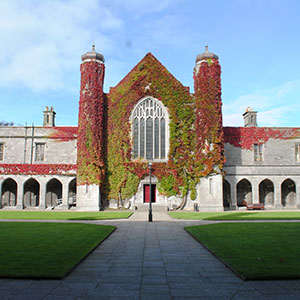
Guiding Breakthrough Research at University of Galway
We explore and facilitate commercial opportunities for the research community at University of Galway, as well as facilitating industry partnership.
-
Alumni & Friends
Alumni & Friends
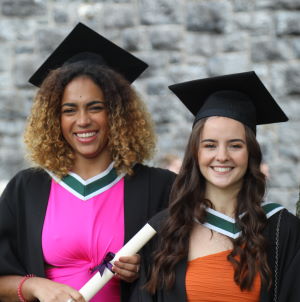
There are 128,000 University of Galway alumni worldwide. Stay connected to your alumni community! Join our social networks and update your details online.
-
Community Engagement
Community Engagement
At University of Galway, we believe that the best learning takes place when you apply what you learn in a real world context. That's why many of our courses include work placements or community projects.
 Accessibility & Language
Tab 3 Content
Professor Shivaun Quinlivan and Dr Charles O’Mahony Launch Major Report on the Future of Disability Rights in Ireland
Jul
29
2026
Posted: 15:24 IST
A new research report was launched Thursday 25th of June at the offices of the Irish Human Rights and Equality Commission.
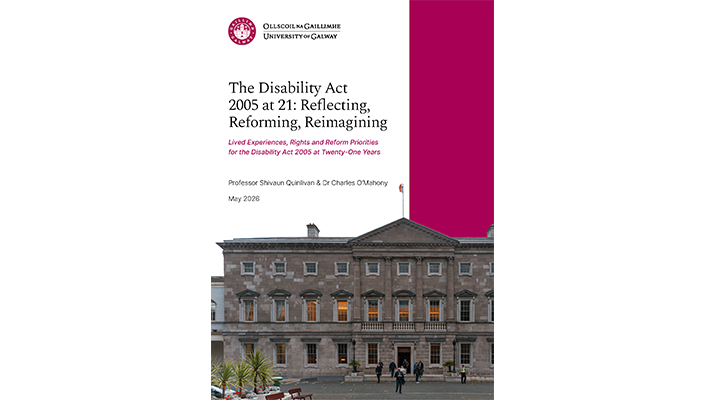
The report, The Disability Act 2005 at 21: Reflecting, Reforming, Reimagining, was produced by Prof Shivaun Quinlivan and Dr Charles O’Mahony of the School of Law at the University of Galway with support from the Department of Foreign Affairs’ Communicating Europe Initiative.
The report argues that Ireland now faces a once-in-a-generation opportunity to transform the Disability Act 2005, the State’s principal disability law, from a framework largely focused on administrative processes and service planning into a modern rights-based statute that guarantees greater accountability, participation, and equality for disabled people.
The report argues that reform is necessary to align Irish law with the United Nations Convention on the Rights of Persons with Disabilities (UN CRPD).
The launch comes at a pivotal moment. In June, the Department of Children, Disability and Equality announced a nationwide consultation on the future of the Disability Act 2005, marking the first comprehensive review of the legislation since its enactment more than twenty years ago.
Drawing on a national survey, stakeholder engagement, and critical legal analysis the report concludes that while the Disability Act 2005 represented a significant legislative achievement at the time of its enactment, it now sits at a crossroads. The legislation was enacted before the adoption of the UN Convention on the Rights of Persons with Disabilities and reflects what the authors describe as a model of policy responsibility for disabled people rather than legal responsibility to disabled people.
The report argues that many of the Act’s core provisions remain constrained by weak enforcement mechanisms, limited accountability, and the absence of effective remedies where statutory obligations are not fulfilled.
Dr Charles O’Mahony said:
“What struck us most throughout this project was not just the scale of frustration with the Disability Act 2005, but the extraordinary clarity, insight, and determination of disabled people and their families about what needs to change. Across the research, the national survey and conference people spoke powerfully about the gap between rights promised and rights realised, between policy commitments and what living in Ireland as a disabled person is like. Participants in the research spoke with hope, ambition, and a vision for a more inclusive and fair Ireland. ”
The report identifies a number of key reform priorities. These include transforming the Assessment of Need process into an enforceable entitlement framework, strengthening accessibility obligations, modernising employment provisions, updating protections relating to genetic testing and emerging technologies such as artificial intelligence, and embedding the principles of the UN CRPD directly into Irish law.
The report also examines how the review process itself should be conducted. Participants strongly supported a review model centred on the meaningful participation of disabled people and Disabled Persons’ Organisations, reflecting the principle of ‘nothing about us without us’ contained in Article 4(3) of the UN CRPD.
Among the proposals emerging from the research are the establishment of an expert review group that includes disabled people and Disabled Persons’ Organisations, structured public consultation, and transparent publication of draft legislative proposals.
While welcoming the Government’s decision to commence a public consultation, the researchers note that meaningful reform will require more than consultation alone.
Professor Quinlivan said:
“The consultation recently announced by Government is an important first step. However, the international evidence and stakeholder feedback gathered through this research project tells us that meaningful reform requires disabled people not simply to be consulted, but to be actively involved in shaping, leading, monitoring, and evaluating the reform process itself.”
The researchers hope the report will serve as a practical resource for disabled people, Disabled Persons’ Organisations, representative bodies, advocates, policymakers, and public bodies preparing submissions to the Government consultation process. That consultation process us open until 5pm on the 9th of September 2026. See here for information on this process.
The full the research report is available here.
A word document version of the research report is available here.