-
Courses
Courses
Choosing a course is one of the most important decisions you'll ever make! View our courses and see what our students and lecturers have to say about the courses you are interested in at the links below.
-
University Life

University Life
Each year more than 4,000 choose University of Galway as their University of choice. Find out what life at University of Galway is all about here.
-
About University of Galway
About University of Galway
Since 1845, University of Galway has been sharing the highest quality teaching and research with Ireland and the world. Find out what makes our University so special – from our distinguished history to the latest news and campus developments.
-
Colleges & Schools
Colleges & Schools
University of Galway has earned international recognition as a research-led university with a commitment to top quality teaching across a range of key areas of expertise.
-
Research & Innovation

Research & Innovation
University of Galway’s vibrant research community take on some of the most pressing challenges of our times.
-
Business & Industry
Guiding Breakthrough Research at University of Galway
We explore and facilitate commercial opportunities for the research community at University of Galway, as well as facilitating industry partnership.
-
Alumni & Friends
Alumni & Friends
There are 128,000 University of Galway alumni worldwide. Stay connected to your alumni community! Join our social networks and update your details online.
-
Community Engagement
Community Engagement
At University of Galway, we believe that the best learning takes place when you apply what you learn in a real world context. That's why many of our courses include work placements or community projects.
 Accessibility & Language
May New research highlights hidden exploitation and abuse of disabled people
New research highlights hidden exploitation and abuse of disabled people
Friday, 29 May 2026
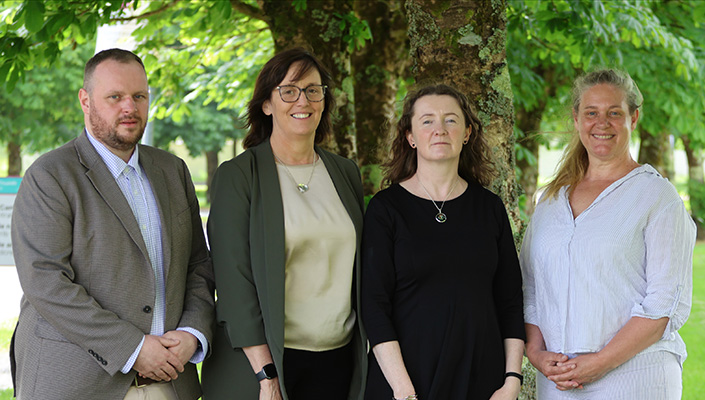
Dr Charles O’Mahony, Associate Professor at University of Galway's School of Law and Principal Investigator of the project, Helen Hall, Chief Executive of the Policing and Community Safety Authority, Fiona McNulty, Community Safety, RISE, Corlann, and Petal Pilley, Director at Blue Teapot Theatre Company. Credit Brian Harding.
University of Galway report examines “mate crime”, safeguarding, and access to justice
A major new research report examining the experiences of disabled people subjected to targeted exploitation and abuse in Ireland has been launched at University of Galway.
The report, Living Independently & Free from Targeted Abuse (LIFT): Understanding Mate Crime and the Experiences of Disabled People, presents findings from a national research project funded by Research Ireland in partnership with the Policing and Community Safety Authority.
The report examines the issue commonly referred to as “mate crime”, where individuals are befriended and manipulated for the purposes of exploitation, coercion, abuse, or criminal activity.
It highlights their experiences including financial exploitation, online targeting, misuse of accommodation, coercive control, sexual exploitation and barriers faced by disabled people when seeking support or reporting concerns.
Participants in the research described experiences involving online scams, financial exploitation, grooming, coercion, social isolation and situations where individuals posing as friends gradually exploited trust.
A recurring theme across the interviews and focus groups was that many participants did not initially recognise what was happening to them as abuse or exploitation, while others were reluctant to report experiences due to shame, fear of losing friendships or relationships, concerns about not being believed, or worries about Garda and justice system responses.
Participants and stakeholders also identified the absence of a specific criminal offence or formal recognition of mate crime in Ireland as contributing to the issue remaining largely hidden.
Participants described experiences of exploitation leading to financial hardship, loss of confidence, fear, emotional distress, social isolation, and significant negative impacts on independent living and participation in their community. Stakeholders and participants strongly agreed that the issue remains significantly underreported.
Dr Charles O’Mahony, Associate Professor in the School of Law at University of Galway and Principal Investigator of the project, said: “This research highlights that many disabled people in Ireland are experiencing serious forms of exploitation and abuse that frequently remain hidden. What makes this particularly complex is that the abuse often develops within relationships presented as friendship, support, care, or trust. The findings demonstrate the need for better safeguarding responses, better awareness, a more accessible justice system, and greater community understanding of how mate crime can occur.”
Helen Hall, Chief Executive of the Policing and Community Safety Authority, said: “The PCSA is delighted to have funded this innovative project, which illustrates the value of bringing academics, practitioners and people with lived experience together to bring real insight into community safety issues. I hope that this research contributes to improving policing services for those at risk of exploitation and abuse by people they trust, by highlighting the need for greater awareness, improved reporting, and a consistent, effective and multi-agency response to a problem that is often invisible.”
Breda Golden, Head of Safeguarding, Corlann, said: “At Corlann, we see how disabled people can be placed at risk simply because they are seeking connection, support, or community. Disabled people in Ireland are being targeted, exploited, and harmed in ways that are too often dismissed or ignored. Mate crime is not a misunderstanding, it is abuse. We need increased awareness and coordinated safeguarding action so disabled people are no longer left to navigate danger alone. Corlann is proud to support this research.”
The research involved key interviews with stakeholders from disability services, advocacy organisations, safeguarding teams, policing, and the justice sector, alongside a national survey and focus groups with disabled people and people supporting individuals in the community across Ireland.
The report includes recommendations relating to disability awareness training, safeguarding legislation, accessible reporting mechanisms, online safety, and stronger coordination between disability organisations, advocacy groups, community services, and An Garda Síochána.
The launch event included a private screening of a short film developed in collaboration with Blue Teapot Theatre Company titled MateCrime. The film was informed directly by the lived experiences and themes emerging from the research.
Petal Pilley, Director at Blue Teapot Theatre Company, said: “On occasion complex social and world issues can be met by art and in the alchemy of that encounter be distilled into forms that communicate truths with immediacy beyond words. We hope this film is one such encounter.”
The event also featured discussion on safeguarding, disability rights, community safety, and access to justice for disabled people in Ireland.
The full report is available here.
Ends
Keywords: Press.
Author: Marketing and Communications Office, NUI Galway
« Back
Related news
28 May 2026
University announces research investment by leading engineering firm Ward & Burke
27 May 2026
Impact of social media on teens may be less than widely assumed
26 May 2026
Researchers puts cancer under pressure to slow tumour growth
25 May 2026
Déanann Ollscoil na Gaillimhe ceiliúradh orthu siúd a bhfuil Gradam Alumni bronnta orthu
25 May 2026
University of Galway celebrates 2026 Alumni Award honourees at annual Gala