-
Courses
Courses
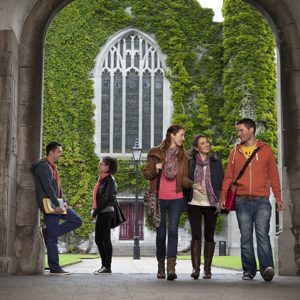
Choosing a course is one of the most important decisions you'll ever make! View our courses and see what our students and lecturers have to say about the courses you are interested in at the links below.
-
University Life

University Life
Each year more than 4,000 choose University of Galway as their University of choice. Find out what life at University of Galway is all about here.
-
About University of Galway
About University of Galway
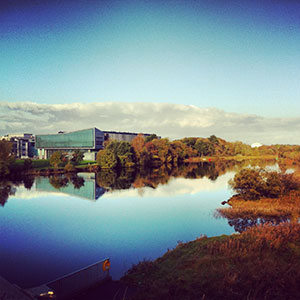
Since 1845, University of Galway has been sharing the highest quality teaching and research with Ireland and the world. Find out what makes our University so special – from our distinguished history to the latest news and campus developments.
-
Colleges & Schools
Colleges & Schools
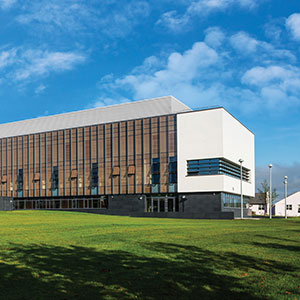
University of Galway has earned international recognition as a research-led university with a commitment to top quality teaching across a range of key areas of expertise.
-
Research & Innovation
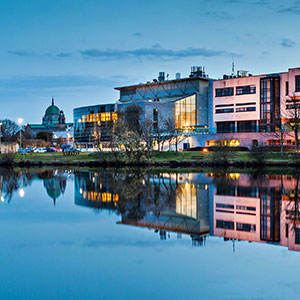
Research & Innovation
University of Galway’s vibrant research community take on some of the most pressing challenges of our times.
-
Business & Industry
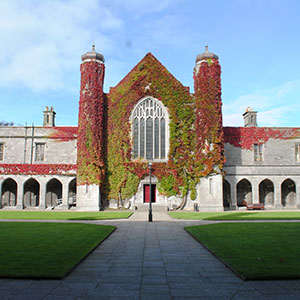
Guiding Breakthrough Research at University of Galway
We explore and facilitate commercial opportunities for the research community at University of Galway, as well as facilitating industry partnership.
-
Alumni & Friends
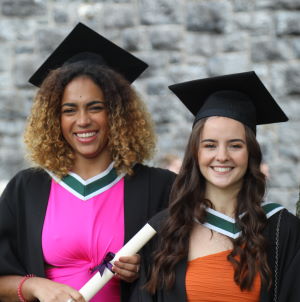
Alumni & Friends
There are 128,000 University of Galway alumni worldwide. Stay connected to your alumni community! Join our social networks and update your details online.
-
Community Engagement
Community Engagement
At University of Galway, we believe that the best learning takes place when you apply what you learn in a real world context. That's why many of our courses include work placements or community projects.
 Accessibility & Language
February Scientists piecing together the puzzle of nerve repair
Scientists piecing together the puzzle of nerve repair
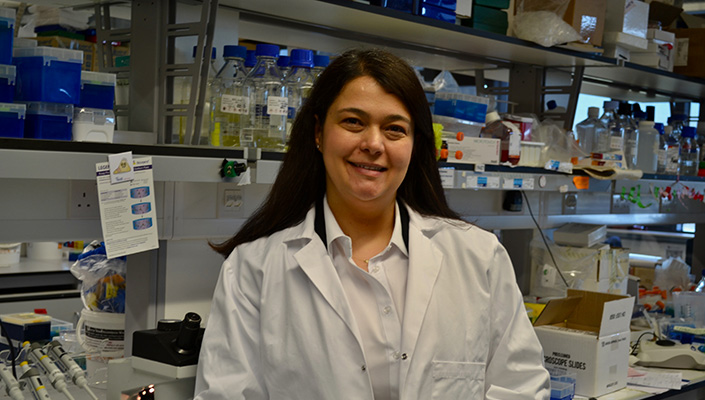
Dr Secil Demir, scientist with CÚRAM. Credit: Mary Deely, CÚRAM.
Feb
20
2026
Posted: 14:34 GMT
An international team of scientists have detailed a new technique to repair and restore function to injury-ravaged nerve tissue.
The research team at CÚRAM, the Taighde Éireann-Research Ireland Centre for Medical Devices based at University of Galway, along with colleagues from Queen Mary University of London and the Mayo Clinic in the US, have published findings of the study in the prestigious journal Cell Biomaterials.
The scientists set out to discover whether new methods to fix damaged nerve tissue could be identified, as the injury can cause irreversible loss of motor and sensory function, chronic pain and long-term disability for patients.
The team reviewed current approaches for repair of nerve tissue, including autografts which are made from a patient’s own nerve tissue; artificial nerve guides or scaffolds, which guide the growth of new nerve tissue; and gene therapy, which would essentially enable new growth.
The research led to the development a collagen-based, neural guidance conduit that embeds and releases specific proteins which promote the survival and development of neurons at the site of injury to promote nerve regeneration.
Dr Secil Demir, scientist with CÚRAM and lead author on the study, said: “Repairing nerve tissue presents a significant technical challenge. Our process was a case of putting together the pieces of a puzzle, based on data generated from years of previous research, to really understand how nerve tissue regenerates and what exactly what is missing at the injury site, that prevents its repair and regeneration. Then we considered all of the current treatment approaches to see if we could address some of the limitations to treating these injuries.”
The treatment system uses proteins which assist with neuronal survival, growth and blood vessel development.
Dr Demir said: “Collaboration with colleagues at the Mayo Clinic in reviewing data from previous studies led us to a combination of the geneserythropoietin (EPO) gene and nerve growth factor (NGF) a protein that promotes the survival and development of neurons. We were able to figure out the best ratio of EPO and NGF to accelerate nerve regeneration and improve functional recovery in larger nerve injuries.”
The model developed by the research team in the lab enables continuous, targeted release of protein within the repair zone, re-engaging key regenerative pathways, offering a clinically translatable strategy to improve peripheral nerve repair.
The research is the first time a non-viral, gene-functionalised collagen conduit, containing optimal ratios of these specific proteins has been used to achieve nerve and blood vessel activation in a large injury.
Professor Abhay Pandit, senior author and Scientific Director of CÚRAM, said: “Integration of this protein-delivery strategy into a clinically validated collagen conduit, addresses some of the core limitations of traditional neural guidance conduits, including limited translation beyond short-gap injuries. These findings align with the growing body of work on biomaterial systems that help regenerate complex tissue and we are excited to look at the next stage of this research.”
The full article is available at here.
Ends
Related News
4 August 2026
Researchers design implant that fights ovarian cancer from the inside
29 July 2026
People of all ages invited to explore mathematical ideas through art
28 July 2026
University of Galway calls for public involvement in developing high blood pressure pathway
27 July 2026
Archaeologists uncover rare Neolithic tombs in Galway
20 July 2026
World premiere of Irish National Opera’s Testament to open at University of Galway